
Project Type Research
Location Vienna, Austria
Year 2016
Acknowledgment Ferrara School of Architecture
The project studies the insertion of an overhead infrastructure in the historical fabric of the city of Vienna as means of reconnecting disjoined parts of the city fabric and of developing new forms of collision and interaction in the complex space of the shared city.
The project does not engage in searching for a hyper-utopian formalism, but it rather proposes a feasible utopia based on a theoretical reflection on the contemporary human condition.
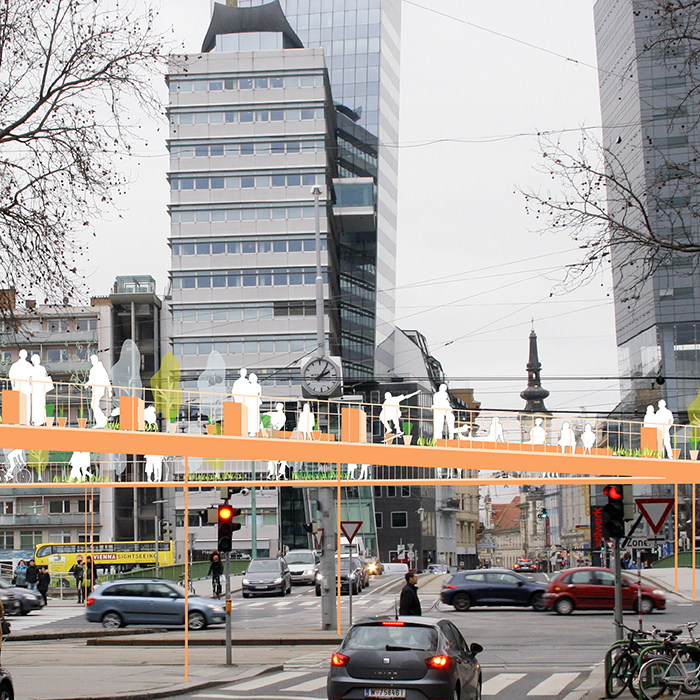
The contemporary city is constantly growing thus combatting its metropolitan hypertrophy is becoming increasingly difficult; so that the attempts to produce places of exchange and relations have led to the creation of “non-places” or spaces without identity, relationships and history. Consequently, the citizens’ identification with their own living space becomes increasingly difficult too. The individual no longer feels the need to define his identity through a social exchange, but he is accidentally trapped into indefinite crossing flows. In the contemporary world, networks, connections, joints and streets turn out to be the generating elements of the city, thus replacing monuments and squares in the functioning and in the representation of a place. Therefore, to research and design new forms of sociability is necessary in these new generation spaces, in order to respond to the citizens’ demands.
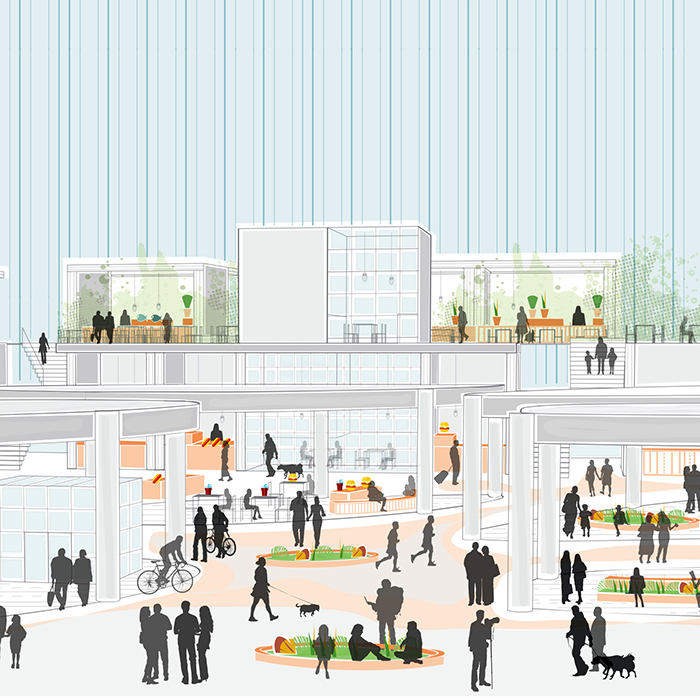
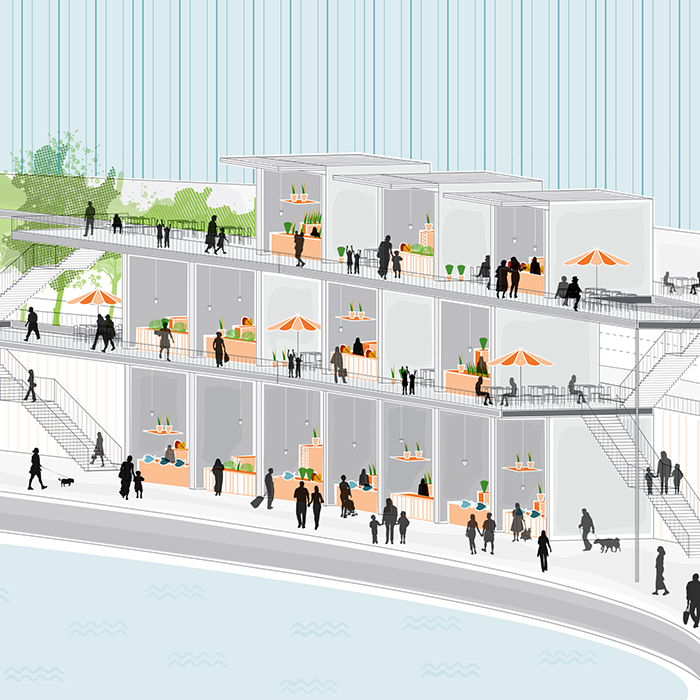
The project picks a specific area in the city of Vienna as case study of the contemporary urban space condition: a central area between the I and II city districts. This area is subject to a pedestrian, vehicular and bicycle traffic that exceeds the 500.000 daily units. It is perceived as a mere crossing space of indifferent traffic flows, which prevents the individuals from any form of social exchange, despite its enormous potential.
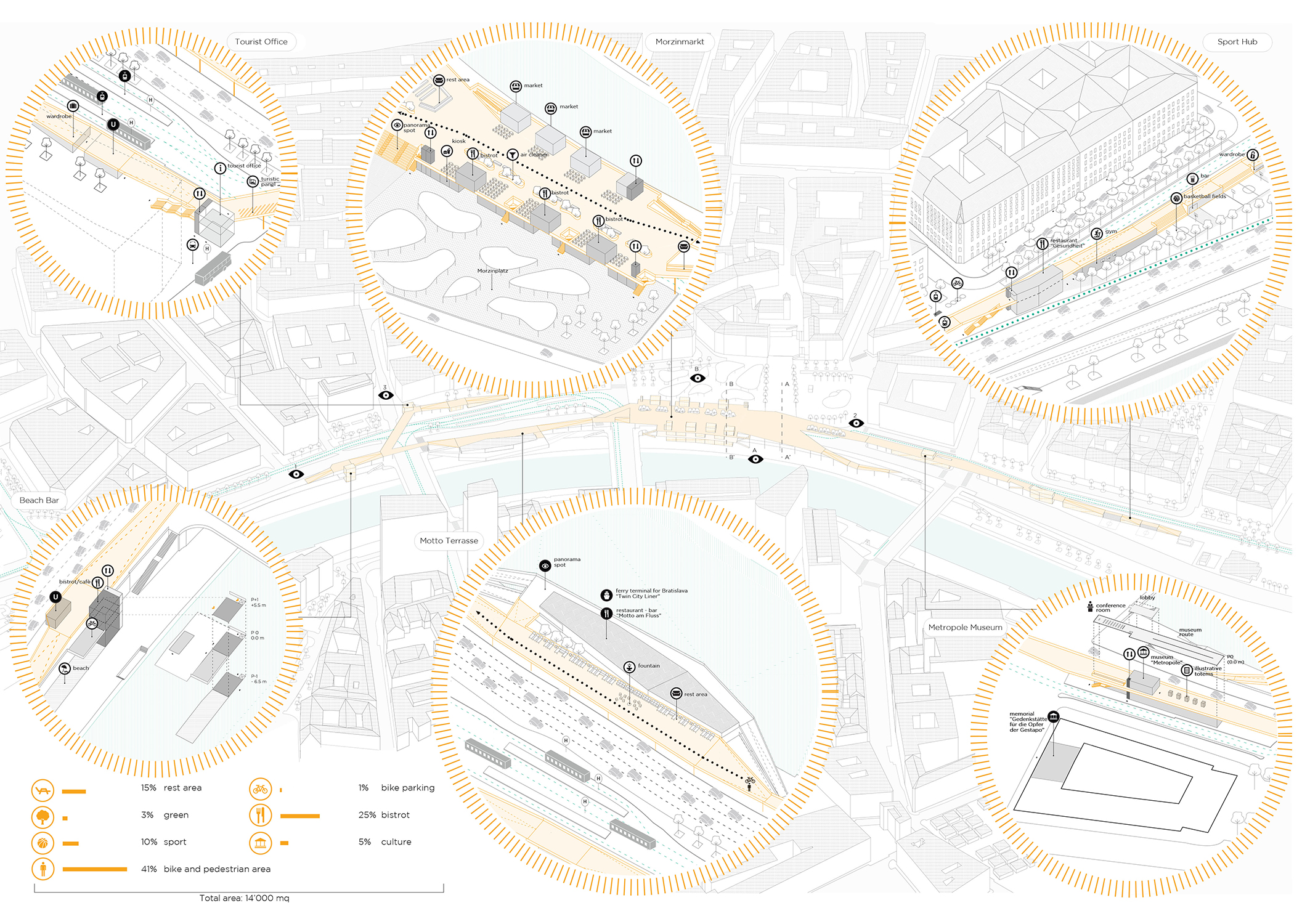
In the project these continuous traffic flows spread a new form of sociability, by transforming the public space into a huge social catalyst, where the random collisions between the crossing flows turn into first encounters. Therefore the project allocates multifunctional volumes in the most significant flows intersections, in oder to provoke a “social collision” among the users who are currently using the public space just as a crossing area.

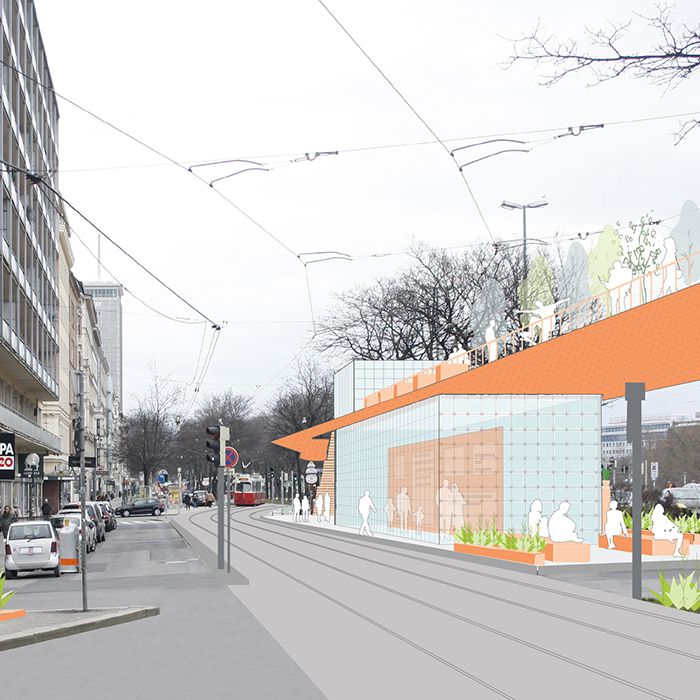
The project aims to create a series of “social condensers” as volumes hosting overlaps and intersections of several programs and activities, and welcoming people with common interests and thus stimulating social interaction. The activities planned in these areas produce a series of new unknown routes that increase the possibility and the intensity of social exchanges. The public space here becomes a two-dimensional projection of the metropolitan condition: an area of “invisible” congestion built on an overlap of functions, movements, activities and programs.
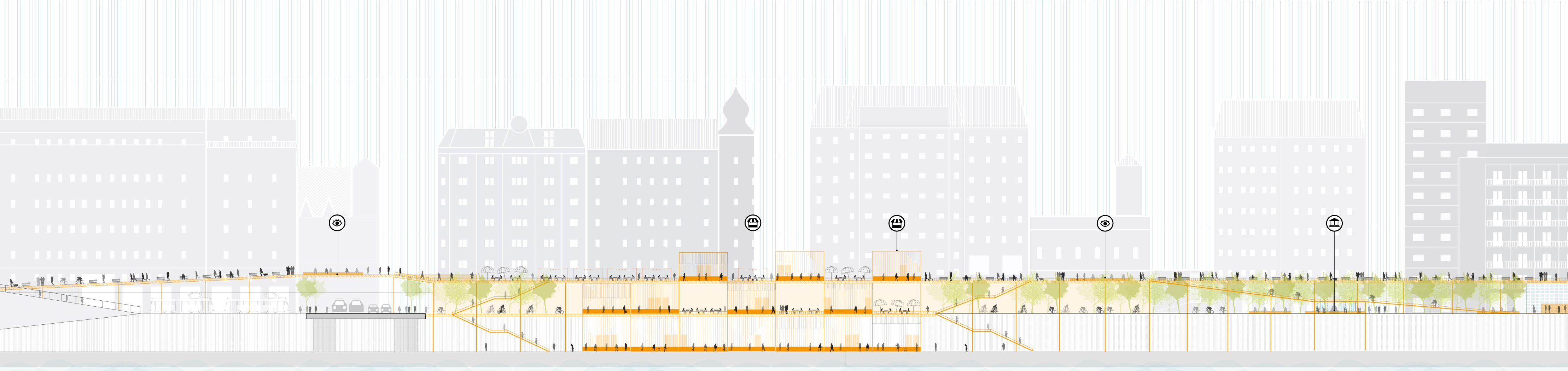
The space has been increased by inserting an elevated infrastructure, that allows for the allocation of functions and planned activities and for the creation of connections among portions of the urban fabric. The infrastructure, as a multifunctional public space, acts like a social catalyst which develops new forms of collision and interaction in the complex and shared city space which is designed for different and flexible uses and is responsive to the needs of the community.
Link to digital publication.
 RINGSCAPE ARCHITECTURE